
Collectible seals cut through the vinyl but not the backing. The cut line is traced from each design at 1 mm, and a single order carries the whole set — a page per design, each with its own quantity, tiled together for press.
No sign-up to try it · 1 mm cut line · A page per design, each with its own quantity

Why seals need their own product
A seal is not a shrunken sticker. At this size the margins that keep a 70 mm sticker safe would swallow the artwork, so the whole spec moves down a class — and it has to move as a set, not one value at a time.
Traced from the artwork itself, close in so the seal keeps its shape rather than sitting in a white field.
1 mm out from the artworkFlagged below 2 mm. Below 1 mm the two cut lines are merged, because that is what the blade does.
2 mm warn · 1 mm mergeA piece whose shorter side drops below this is flagged before the order can be placed.
5 mmFor comparison, a free-form die-cut sheet runs 5 mm / 3 mm / 30 mm. Same editor, different class of product — and the values live on the product, not in the code.
Sizes
The size you sell is the finished, trimmed seal. The editing page is 1 mm larger on every side, so your customer never has to think about bleed.
| Format | Finished size | Editing page |
|---|---|---|
| Seal | 40 × 40 mm | 42 × 42 mm |
| Seal, wide | 50 × 40 mm | 52 × 42 mm |
| Large seal | 70 × 90 mm | 72 × 92 mm |
| Photocard seal | 85 × 55 mm | 87 × 57 mm |
Position and size are shown in millimetres and inches at the same time while the customer drags, so a seller working in inches and a printer working in millimetres are reading the same canvas.
Photocard size included: use the same multi-design seal workflow with an 85 × 55 mm finished format.
A set, not a sticker
Seals are bought in sets. The editor is built for that: the customer adds a page, puts the next design on it, and keeps going. You are not asking them to place six separate orders, and you are not receiving six separate files.
This is what a seal order actually looks like: not one design ordered ten times, but ten designs ordered in the amounts someone wants. Asking for that as ten separate orders is how sellers lose the basket.
Ten designs, ten pages, one print-ready PDF.
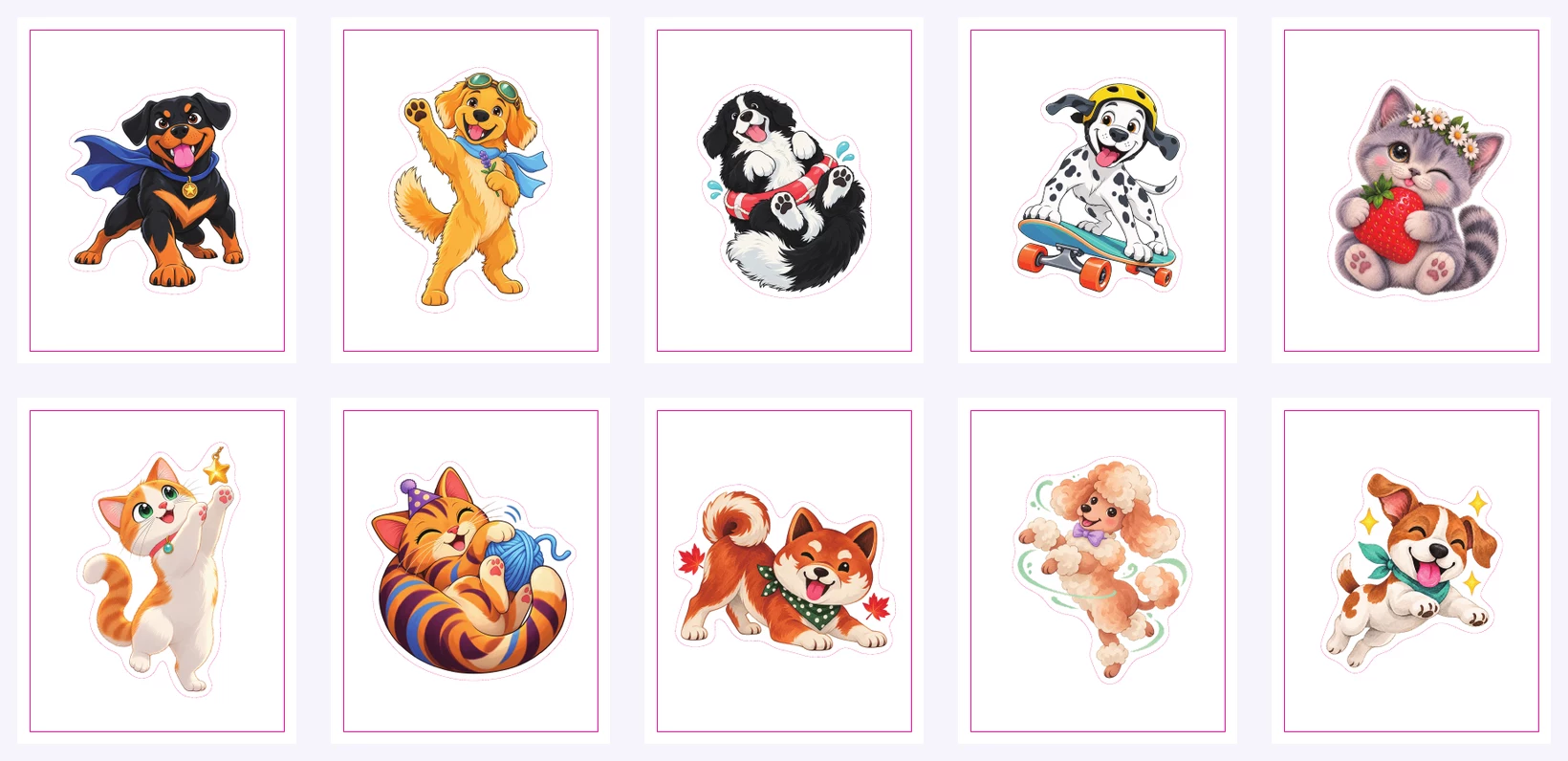
10 designs → 10 pages → 1 PDF
Overprint and transparency are resolved before the file reaches you.
Your catalogue
Start from any seal preset and set your own size, cut margin and safe area. The shape and cut type stay locked to the base, so the production spec cannot drift — and editing a preset never changes products you already created.
FAQ
A small sticker cut through the vinyl only, so it stays on its backing until it is peeled off. They are usually sold as sets and collected, which is why an order tends to carry several designs rather than one.
The customer adds pages in the editor and puts a different design on each. Every page keeps the same spec, and the pages are tiled together onto the press sheet at nesting time.
Yes. Every page in the order carries its own quantity, so a customer can take three of one design and one of another without splitting it into separate orders.
The cut line is traced 1 mm out from the artwork, and a piece whose shorter side falls under 5 mm is flagged in the editor. Below a 2 mm gap two pieces are flagged; below 1 mm their cut lines are merged.
40×40 mm, 50×40 mm, 70×90 mm and the 85×55 mm photocard format out of the box, plus any size you create from them in your settings.
Yes. Photocard seals use the same kiss-cut workflow as collectible seals: add one design per page, set a different quantity for each design, and receive the complete order as one print-ready file.
No sign-up, no install. Add a page, drop in a design, and watch the cut line appear.